

Addis Ababa has long been described as the diplomatic capital of Africa. It is here that Ambassadors, Ministers, and Heads of State gather to negotiate continental priorities, debate policy direction, and attempt to align the interests of fifty-four countries under a shared institutional framework.
Yet the public view of the African Union often focuses on the spectacle of summits. Television cameras capture leaders arriving for high-level meetings, communiqués are issued at the conclusion of negotiations, and headlines briefly turn toward the organisation before attention shifts elsewhere.
What remains less visible is the diplomatic machinery that operates between these moments.
Much of the work of the African Union unfolds away from plenary halls and formal announcements. Negotiations take place in committee rooms, technical working groups, and consultations between permanent representatives stationed in Addis Ababa. These diplomats form the backbone of the organisation’s day-to-day diplomacy, translating political ambitions into negotiated positions that can command continental consensus.
Consensus itself is one of the defining features of African Union diplomacy. Unlike institutions where voting blocs frequently determine outcomes, AU decision-making often emphasises dialogue and compromise. Positions are refined through extended consultation until member states can support a shared outcome. This process can be slow and, at times, frustrating for observers expecting rapid decisions. But it also reflects a diplomatic culture that prioritises inclusion and collective ownership of continental decisions.
The system requires patience and political skill.
Diplomats in Addis Ababa operate within a complex environment where national interests, regional alignments, and continental aspirations intersect. Negotiations may involve not only governments but also the AU Commission, specialised agencies, and regional economic communities. Each actor brings its own perspective on how continental policy should evolve.
In recent years, the scope of these negotiations has expanded considerably. Issues such as economic integration, peace and security coordination, digital governance, and Africa’s engagement with global partners now occupy significant space within AU deliberations. As a result, the technical expertise required of diplomats has grown alongside their political responsibilities.
The city itself reflects this diplomatic intensity. Addis Ababa hosts one of the largest concentrations of diplomatic missions on the continent. Ambassadors accredited to the African Union maintain close working relationships with their counterparts, meeting regularly to discuss emerging issues before they reach formal negotiation stages. Informal consultations, corridor discussions, and small group meetings often shape the direction of negotiations long before official sessions begin.
In this sense, diplomacy in Addis Ababa resembles the workings of other major diplomatic capitals around the world. Influence is exercised not only through formal statements but also through relationships, reputation, and the ability to navigate complex institutional dynamics.
The African Union’s decision-making process can sometimes appear opaque to those outside these circles. Yet its gradual and deliberative nature reflects the broader challenge of governing a continent defined by diversity in political systems, economic priorities, and historical experiences.
What emerges from Addis Ababa is therefore rarely the result of a single negotiation or meeting. Instead, it is the product of sustained diplomatic engagement across multiple layers of institutional interaction.
Understanding the African Union requires looking beyond the summit stage and into the corridors where its diplomacy is practiced daily.
In those corridors, the future direction of continental cooperation continues to be negotiated.
How Addis Ababa Became Africa’s Diplomatic Capital
Addis Ababa’s position at the centre of Africa’s diplomatic life was not inevitable. It emerged from a particular historical moment in which newly independent African states sought a common political platform through which to articulate their collective aspirations and defend their sovereignty in a rapidly changing international order.
What we require is a single African organisation through which Africa’s single voice may be heard, within which Africa’s problems may be studied and resolved. We need an organisation which will facilitate acceptable solutions to disputes among Africans and promote the study and adoption of measures for common defence and programmes for co-operation in the economic and social fields. Let us, at this Conference, create a single institution to which we will all belong, based on principles to which we all subscribe, confident that in its councils our voices will carry their proper weight, secure in the knowledge that the decisions there will be dictated by Africans and only by Africans and that they will take full account of all vital African considerations.
Emperor Haile Selassie
25 May 1963
Address to African Leaders at Founding OAU Summit, Addis Ababa.
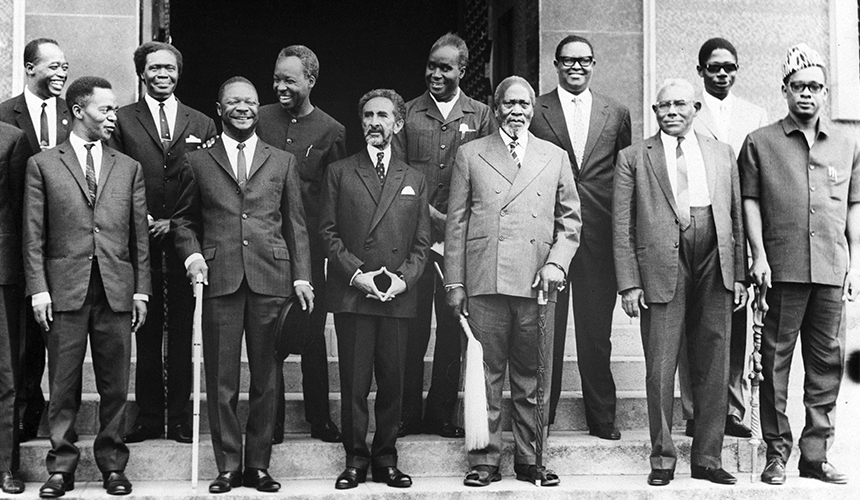
Haile Selassie at the founding OAU Summit, Addis Ababa, May 1963.
Photo Source: African Union History of Founding Fathers
Addis Ababa’s position at the centre of Africa’s diplomatic life was not inevitable. It emerged from a particular historical moment in which newly independent African states sought a common political platform through which to articulate their collective aspirations and defend their sovereignty in a rapidly changing international order.
That moment arrived in May 1963 when leaders from across the continent gathered in Addis Ababa to establish the Organisation of African Unity, the institution that would later evolve into the African Union. The creation of the organisation marked the first formal attempt by African governments to institutionalise continental cooperation and provide a permanent forum for addressing political, economic, and security concerns affecting the continent.
Ethiopia played a decisive role in convening that historic meeting. Under the leadership of Emperor Haile Selassie, the country positioned itself as a diplomatic bridge among African states emerging from colonial rule. Ethiopia’s own history of maintaining sovereignty during the colonial era gave it a unique symbolic standing at a time when questions of independence and self-determination dominated the political agenda across the continent.
For many African leaders of the early post-independence period, Addis Ababa represented more than simply a host city. It carried political meaning. Ethiopia had resisted permanent colonisation and had long served as a reference point for African sovereignty. Locating the headquarters of the new continental organisation in Addis Ababa therefore reinforced the idea that African unity would be anchored in a space that symbolised independence and resilience.
The founding of the Organisation of African Unity transformed Addis Ababa into a permanent diplomatic centre. Ministers, heads of state, and diplomats began travelling regularly to the city for consultations on issues ranging from liberation struggles in southern Africa to mediation efforts in regional conflicts. Over time, embassies and diplomatic missions expanded their presence in the Ethiopian capital to maintain closer engagement with the organisation’s activities.
This steady accumulation of diplomatic activity gradually reshaped the city’s international profile. Addis Ababa became home not only to African diplomatic missions but also to a growing number of international organisations seeking to engage African governments collectively. Among them is the United Nations Economic Commission for Africa, which is also headquartered in the city and plays an important role in supporting regional economic cooperation and development policy across the continent.
The transformation accelerated with the establishment of the African Union in 2002, which replaced the Organisation of African Unity and expanded the institutional ambitions of continental cooperation. The African Union introduced a more elaborate organisational framework designed to address governance, development, peace and security, and economic integration across the continent.
Central to this structure is the African Union Commission, the administrative body responsible for coordinating the Union’s programmes and implementing the decisions of member states. Through its departments and specialised units, the Commission functions as the institutional engine of the organisation, supporting policy initiatives and facilitating cooperation among governments.
Additional organs further reinforced Addis Ababa’s position as the epicentre of continental diplomacy. Among them is the Peace and Security Council, a standing decision-making body responsible for conflict prevention, peacekeeping coordination, and crisis response across Africa.
The presence of these institutions has helped create one of the largest diplomatic communities on the continent. Permanent missions accredited to the African Union operate alongside embassies accredited to Ethiopia, forming a dense network of diplomats whose work spans bilateral, regional, and continental engagements.
Informal consultations, corridor discussions, and working-level negotiations are now routine features of diplomatic life in the city. Long before major decisions are formally announced at African Union summits, diplomats in Addis Ababa spend months refining policy proposals, negotiating compromises, and building the consensus necessary for continental agreements.
The result is a diplomatic ecosystem unlike any other in Africa. Decisions emerging from Addis Ababa frequently shape continental governance frameworks, influence regional initiatives, and frame Africa’s collective engagement with global partners.
More than six decades after African leaders first gathered to establish the Organisation of African Unity, Addis Ababa remains the place where Africa’s diplomatic architecture is most visibly institutionalised. The city continues to serve as the principal forum where African governments negotiate the policies and partnerships that shape the continent’s political future.
In the corridors of Addis Ababa’s institutions, Africa’s diplomatic story continues to unfold.
